



Climate change demands urgent and decisive action across all sectors of the global economy, with manufacturing playing a critical role.
As a major contributor to global greenhouse gas emissions, the manufacturing sector faces an urgent imperative to radically transform its operations and mitigate climate change.
The Asia-Pacific region, particularly major economies like China, India, Japan, South Korea, and ASEAN nations, has been a significant contributor to greenhouse gas (GHG) emissions.
In 2020, these 49 countries collectively emitted over half of the world's greenhouse gases. While Malaysia's share is relatively small at 0.7% of global emissions (according to the 12th Malaysia Plan), the manufacturing and construction sectors within the country rank as the third-largest source of GHG emissions.
While the industry faces increasing pressure to reduce its environmental footprint, it remains a vital driver of economic growth.
The Asia-Pacific manufacturing sector is on a strong trajectory, with projections pointing to a steady compound annual growth rate (CAGR) of approximately 1.76% from 2025 to 2029.
This growth is evident in countries like Indonesia, which has become a magnet for foreign direct investment (FDI) in manufacturing. In 2023, Indonesia attracted a substantial $28.7 billion in manufacturing investment, solidifying its position as a rising star in the sector.
As climate change concerns intensify and environmental regulations tighten, many manufacturers are turning to sustainable solutions to achieve net zero emissions.
Renewable Energy Certificates (RECs) offer one of the strategic components of a broader sustainability strategy, enabling manufacturing businesses to mitigate their carbon footprint to meet their sustainability targets.
Understanding RECs and Their Benefits
In short, RECs are tradable commodities that incentivize renewable energy production by representing the environmental attributes of clean and renewable electricity generation.
Each certificate comes with details about:
1. Certificate Data
- Certificate type
- Tracking system ID
- Unique Serial Number
2. Renewable Energy Details
- Renewable fuel type (e.g.,solar, hydro, biomass)
- Renewable facility location
- Nameplate capacity of the project
- Project name and vintage (build date)
- Certificate (generation) vintage
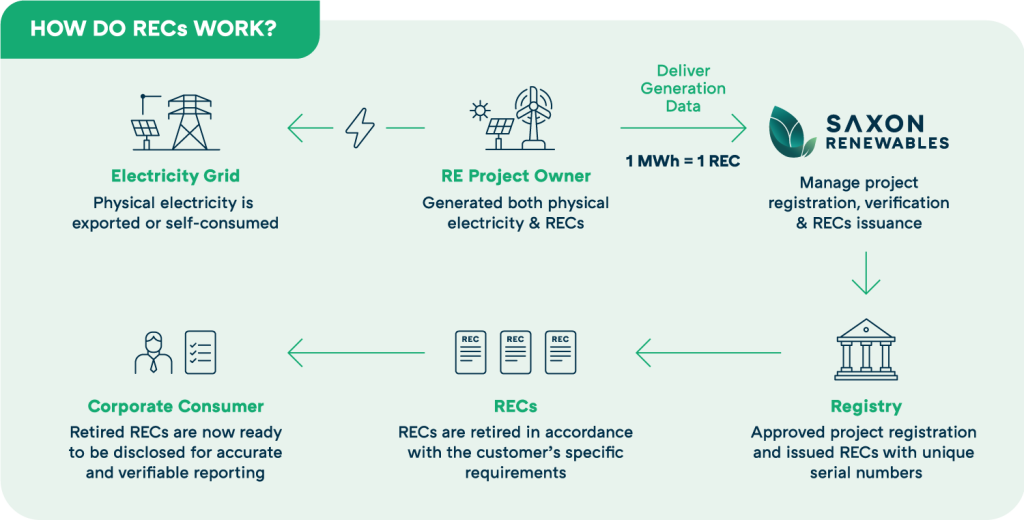
Once a megawatt-hour (MWh) of renewable electricity is generated and delivered to the grid, a REC is created and can be traded on the market.
Types of RECs
RECs are a key mechanism in the renewable energy market, coming in two primary forms: bundled and unbundled.
Both types are essential for supporting renewable energy development and assisting organizations meet sustainability goals.
- Bundled RECs
Bundled RECs are sold together with the renewable electricity they represent. This is a common arrangement for new renewable energy projects, as the combined sale of electricity and RECs provides developers with a reliable income stream, which is often crucial for securing project funding.
Organizations purchasing bundled RECs contribute to “additionality,” meaning their investment plays a direct role in enabling new renewable energy generation and displacing fossil fuel-based sources.
- Unbundled RECs
Unbundled RECs are sold separately from the electricity they represent. These certificates allow companies to claim the environmental benefits of renewable energy, regardless of where they source their electricity.
While unbundled RECs may not be directly tied to new projects, they are still a valuable tool for organizations aiming to reduce their scope 2 carbon footprint. They also provide a revenue stream to renewable energy generators, supporting the broader transition to clean energy.
By offering both bundled and unbundled RECs, Saxon ensures organizations have flexible and impactful options to meet their sustainability goals while contributing to the growth of the renewable energy market.
Variations of RECs
The core concept of RECs remains consistent globally, although the specific terminology used to describe these certificates may vary.
Numerous standards govern the issuance, tracking, and retirement of RECs, and these standards may employ different names for the certificates they generate:
| Regions / Countries | RECs |
|---|---|
| China | Green Electricity Certificates (GEC) |
| Europe | Guarantee of Origin (GOs) |
| International |
(a) International Renewable Energy Certificates (I-REC) (b) Tradable Instrument for Global Renewables (TIGR) |
| Japan | J-Credit |
| Korea | K-RECs |
| New Zealand | New Zealand Energy Certificate System (NZECs) |
| North America | Energy Attribute Certificates (EACs) |
| Taiwan | Renewable Energy Certificates (T-RECs) |
Benefits of RECs for Manufacturing Companies
Manufacturing companies committed to environmental sustainability can reap significant benefits from leveraging RECs. The implementation of RECs into your operations allows you to gain in various areas such as:
1. Business Benefits
- Good Environmental Record
Incorporating RECs into your business will help offset Scope 2 emissions, meet sustainability goals, and enhance your brand image as sustainability leaders.
This demonstrates your commitment to addressing climate change, enhancing your brand image as a sustainability leader and positioning your company favorably in the eyes of environmentally conscious consumers.
Using RECs directly supports the renewable energy market, verifying that the electricity consumed is sourced from clean energy production.
Such a strategy strengthens a company's ESG (Environmental, Social, and Governance) credentials, aligns with global climate goals, and bolsters brand reputation among eco-conscious consumers and investors.
2. Environmental Benefits
- Reduced Carbon Footprint
Harnessing RECs allow manufacturers to reduce their carbon footprint, particularly Scope 2 emissions associated with purchased electricity.
This presents a powerful opportunity for businesses to minimize their environmental impact, future-proof their operations, and directly support the growth of renewable energy production.
- Contribution to a Greener Future
By embracing renewable energy, you’ll be playing a key role in advancing the transition to a sustainable energy system, helping to combat climate change and secure a healthier planet for future generations.
- Market Impact
Businesses aiming to offset their emissions or speculators seeking investment opportunities can trade RECs as valuable financial assets.
This grants REC consumers the flexibility to source renewable energy from a diverse range of domestic and international providers, providing greater control over their clean energy procurement.
For instance, an Asian company with operations in Europe and the USA can enhance its sustainability profile by purchasing RECs from renewable energy projects in these regions.
RECs provide evidence that the company supports renewable energy generation and offsets its electricity use with clean energy, promoting its commitment to sustainability across all locations.
In its commitment to environmental sustainability, industry giants like Apple Inc. sources RECs from diverse regions across the globe, including the Asia-Pacific (APAC) region.
By acquiring RECs from markets such as China, South Korea, India, and Japan, Apple actively supports the development of renewable energy projects and contributes to a cleaner energy future.
This strategic approach underscores Apple’s dedication to achieving carbon neutrality by 2030 and aligns with its broader vision of a sustainable and environmentally responsible global supply chain.
As the world shifts towards a low-carbon economy, your company has a valuable opportunity to embrace a sustainable future. Failure to do so can lead to lost market share and regulatory challenges
Navigating the RECs Market
The growing momentum behind renewable energy is undeniable. In 2023 alone, the RECs market witnessed the issuance of 283 million certificates, representing a significant 283 TWh of clean electricity.
This remarkable growth signifies a 42% surge compared to 2022.
Driven by a confluence of factors, including corporate sustainability goals, supportive policies like Malaysia’s Renewable Energy Transition Roadmap, regional initiatives such as the ASEAN Plan of Action for Energy Cooperation, and the outcomes of COP28, the demand for voluntary Renewable Energy Certificates (RECs) is accelerating, particularly within sectors like data centers and manufacturing.
These factors have collectively reinforced global commitments to renewable energy, pushing countries and companies towards ambitious carbon reduction targets. As a result, voluntary RECs are increasingly sought after as a viable mechanism to achieve these goals.
Additionally, the recent expansion of REC trading windows by the Central Electricity Regulatory Commission (CERC) has boosted market liquidity in the Asia-Pacific region, particularly India, leading to increased REC trading volumes.
Southeast Asia’s Renewable Energy Certificate (REC) market is experiencing significant growth, with solar and wind REC issuances rising nearly 13-fold between 2019 and 2023.
This surge is driven by corporate sustainability goals and supportive policies across the region. For instance, Thailand’s Electricity Generating Authority has emphasized the importance of regional integration to reduce REC costs and enhance accessibility.
How RECs Aligns Your Business with Global Climate Goals
In response to the escalating global climate crisis, the world is on a journey towards sustainable practices, with numerous goals and agreements undertaken to mitigate this pressing issue:
1. Paris Agreement
The Paris Agreement was adopted in 2015 and aims to limit global warming to well below 2°C above pre-industrial levels, with efforts to limit the increase to 1.5°C. This agreement underscores the critical role of renewable energy in mitigating greenhouse gas emissions, with the global goal of achieving net-zero emissions between the year 2050 and 2100.
By adopting energy efficiency measures and increasing renewable energy use in the manufacturing sector, significant reductions in carbon emissions can be achieved, contributing to the temperature targets set in the Paris Agreement.
2. RE100
RE100 is a collaborative global initiative bringing together influential businesses committed to 100% renewable electricity.
Companies that join RE100 pledge to source 100% of their global electricity consumption from renewable sources. This initiative is gaining significant traction, with major corporations like Apple, Google, and Microsoft leading the way in corporate sustainability.
RE100 primarily targets large corporations that consume at least 100 GWh of electricity annually. However, there are exceptions for smaller companies if they meet certain criteria, such as being recognized industry leaders, listed in the Fortune 1000, or significant players in priority regions or sectors.
These exceptions allow influential smaller companies to join RE100 and commit to sourcing 100% of their electricity from renewable sources, even if they don’t meet the 100 GWh consumption threshold.
3. How Can RECs Help You Meet Your Global Climate Goals?
RECs help businesses align with global climate goals by supporting the development of renewable energy projects, which increases the share of renewable energy in the grid and reduces reliance on fossil fuels. This contributes to the Paris Agreement’s goal of limiting global warming to well below 2°C.
Moreover, RECs enable companies to meet sustainability targets and commitments to initiatives like RE100, which requires 100% renewable electricity.
This demonstrates corporate responsibility, enhances reputation, and provides a competitive edge. RECs also help businesses stay ahead of regulatory compliance and adapt to evolving regulations, ensuring a sustainable future.
5 Effective Steps to Adopt RECs
Embarking on your sustainability journey today with RECs is as simple as jumping on the bandwagon towards a greener future for your company.
At Saxon, we provide expert guidance at every stage of the RECs process, that includes expert guidance on REC selection and compliance from experienced professionals.
1. Understanding Your Baseline Emissions
Start by assessing your company’s carbon footprint. Inventory all energy-consuming processes, categorize energy sources, and measure consumption using established methods like the Greenhouse Gas Protocol.
While calculating, considering both direct (Scope 1) and indirect (Scope 2) emissions is crucial for an accurate assessment.
2. Explore and Evaluate Your Renewable Energy Options
Given the diverse range of renewable energy options, selecting the most suitable solution for your company is imperative.
Consider on-site generation methods such as solar or wind power, depending on your location and resources.
Alternatively, you can explore off-site procurement through Power Purchase Agreements (PPAs) or Renewable Energy Certificates (RECs).
3. Select a Reliable Renewable Energy Partner
When choosing a professional renewable partner, it’s essential to evaluate their credibility and certification.
Ensure that your potential RECs supplier is certified by reputable organizations and can provide detailed information about the source and environmental attributes of the RECs.
To ensure a seamless experience, we prioritize transparent tracking and verification, competitive pricing, and customizable delivery options tailored to your specific needs.
Our sustainability team at Saxon provides comprehensive support throughout the entire process, guiding you through project registration, verification, and RECs issuance.
4. Approval and Issuance of RECs
Manufacturers must register their projects with recognized registries like TiGR or I-REC to fully leverage the benefits of RECs.
Each issued REC receives a unique serial number, ensuring accurate tracking and preventing fraudulent claims
5. Retire, Report, and Enjoy the Benefits!
Retiring Renewable Energy Certificates (RECs) is essential for claiming environmental benefits associated with renewable energy generation.
This process involves manufacturers registering the REC within the designated tracking system and marking it as ‘used’, ensuring its authenticity and preventing double-claiming.
Saxon Renewables helps simplify your REC retirement, handling the process according to your specific requirements.
The retirement of RECs enables manufacturers to disclose them in their sustainability reports, showcasing their commitment to renewable energy and greenhouse gas emission reduction.
Expert Guidance at Every Step of Your Sustainability Journey
While RECs are a significant tool to offset scope 2 carbon emission and achieve 100% renewable energy, RECs represent just one part of sustainability initiatives.
As a comprehensive climate change solutions provider, Saxon Renewables is dedicated to helping businesses like yours achieve sustainability targets and align with global standards such as RE100, CDP, and SBTi, Saxon Renewables is committed to helping businesses like yours achieve their sustainability goals.
Together, we accelerate a sustainable future.
Contact us today to discuss your sustainability goals!
FAQ
In contrast, carbon credits represent a measurable reduction or avoidance of emissions, quantified in metric tons, achieved through projects such as reforestation, renewable energy development, and methane capture. Carbon credits are further categorized into technology-based credits, which come from innovations like renewable energy and carbon capture, and nature-based credits, generated through efforts like reforestation and ecosystem preservation. Businesses can use carbon credits to offset Scope 1, 2, and 3 emissions.
While RECs focus on promoting renewable energy generation and reducing indirect emissions from purchased electricity, carbon credits address both direct and indirect emissions by supporting projects that reduce or remove GHGs from the atmosphere.
The price of Renewable Energy Certificates (RECs) fluctuates based on several key factors, including:
- Supply and demand dynamics: Availability of RECs supply and market demand.
- Global disclosure standards and requirements: Compliance with frameworks like RE100, CDP, and SBTi.
- Geographical considerations: Location of the renewable energy project.
- Energy source quality: Type of renewable energy, such as solar, wind, or hydro.
- REC vintage: Year the renewable energy was generated.
Acquiring RECs not only supports renewable energy generation but also helps your organization align with global standards like RE100, CDP, and SBTi, showcasing leadership in sustainability and compliance with recognized frameworks.
APX-TIGR certificates typically have a validity period of up to one year.