


Practical Pathways for Reducing Scope 2 Emissions
In Asia-Pacific, purchased electricity represents the largest source of Scope 2 greenhouse gas emissions, making renewable electricity sourcing critical for credible decarbonization.
Under the Greenhouse Gas (GHG) Protocol, Scope 2 emissions are defined as the indirect emissions from the generation of grid-supplied electricity, steam, heat, or cooling consumed by your operations.
In many fast-growing economies where coal and gas still dominate the energy mix, this challenge also presents a significant opportunity.
Organizations that proactively address their energy sourcing can lead regional decarbonization efforts, enhance competitiveness, and meet rising stakeholder expectations for sustainability leadership.
Meanwhile, how organizations source and account for electricity is coming under sharper scrutiny from regulators, investors, and customers alike.
Related: Why Are Scope 1, 2 & 3 Carbon Emissions Significant?

Consult Decarbonization Experts
Understanding the Fundamentals of RECs
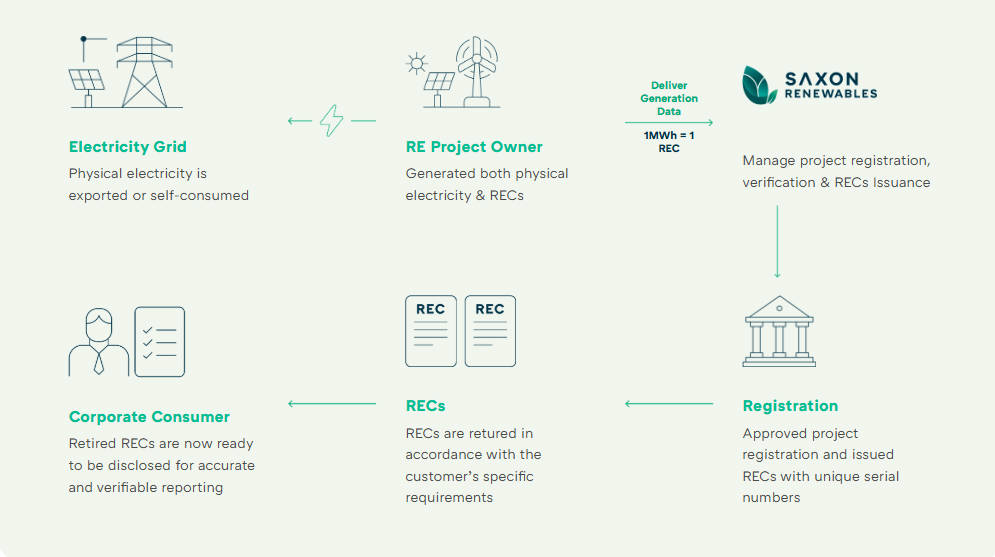
Renewable Energy Certificates (RECs) are a globally recognized market instrument to demonstrate the use of renewable electricity and support emissions reduction goals. One REC represents 1MWh of renewable power generated and fed into the grid.
RECs can be bundled with electricity or purchased unbundled as a standalone digital certificate. Each REC must be retired for an organization to make a valid claim. Eligible renewable sources include solar, wind, hydro, biomass, and geothermal — all contributing to the energy transition.
Most APAC countries (e.g., Singapore, Vietnam, Malaysia) do not have their own domestic REC registry. Organizations commonly source renewable energy through the following internationally recognized certificates:
International RECs (I-RECs)
I-RECs are the globally recognized and standardized certificates, allowing organizations to reliably track and make renewable energy usage claims in compliance with market-based Scope 2 accounting under the GHG Protocol.
They are issued in participating countries worldwide, but not in Europe or North America, where systems such as Guarantees of Origin (GOs) or US RECs are used.
The scheme is governed by the I-REC Standard Foundation, ensuring global consistency in issuance, transfer, and retirement processes.
Tradable Instruments for Global Renewables (TIGRs)
TIGRs are renewable energy tracking certificates issued by APX. Functionally similar to I-RECs, TIGRs provide verifiable proof of renewable energy generation in select international markets, enabling global organizations to source renewables across regions.
The Growing Emphasis on Additionality

Photo by Unsplash
As the REC market matures, organizations are recognizing that meeting basic compliance is no longer enough. Today’s stakeholders demand genuine impact, or you can say “additionality”.
Additionality means that REC purchases should contribute to the development of new renewable energy projects that wouldn’t have occurred otherwise.
This shift creates a meaningful opportunity for organizations to drive real-world climate benefits and demonstrate authentic leadership in sustainability.
While not all RECs deliver this directly, many organizations are now exploring options that at least support this outcome indirectly:
EKOenergy-labelled RECs
One credible pathway is sourcing EKOenergy-labelled RECs. For every MWh, at least €0.10 is directed to the EKOenergy Climate Fund, which finances clean energy projects in remote communities across developing countries.
These projects are selected through a transparent process, contribute to the UN Sustainable Development Goals (SDGs), and ensure that demand leads to new renewable installations where they are most needed.
24/7 Carbon-Free Electricity (CFE)
Another emerging frontier in renewable energy sourcing is hourly matching, or 24/7 Carbon-Free Electricity (CFE).
Instead of purchasing annual or monthly RECs, companies align their energy consumption with clean energy generation on an hourly basis, creating a more precise link between when electricity is used and when renewable power is produced.
Currently, adoption is concentrated among data centres and organizations with advanced energy tracking capabilities. As technology platforms mature and become more accessible, 24/7 CFE could evolve into a powerful complement to traditional RECs, accelerating deeper decarbonization and delivering greater system-wide impact.
How to Stay Credible With Evolving Global Frameworks
Adhering to best practices is essential to building credible and defensible climate claims:
- Market Boundaries: Ensure RECs are sourced from the same market where your electricity is consumed. This prevents double counting and ensures your renewable energy claims reflect actual local impact.
- Vintage: Align the generation period of your renewable energy with your consumption period. Matching these timeframes ensures accurate GHG accounting and credible emissions reductions.
- Technology Type: Understand which renewable energy sources comply with internal or external requirements, ensuring that only eligible and credible sources contribute to your sustainability claims.
These principles are embedded in leading frameworks such as the GHG Protocol, Carbon Disclosure Project (CDP), and RE100. CDP assesses organization on the transparency and quality of environmental reporting, while RE100 details the eligibility criteria for renewable energy sources and claims.
As interpretations and regulations continue to evolve (such as the GHG Protocol’s ongoing consultations and RE100’s tightening of technology rules), organizations should actively monitor updates to ensure claims remain robust and compliant.
A Strategic Lever for Lasting Decarbonization
Renewable Energy Certificates (RECs) are more than just compliance tools. When integrated within a comprehensive decarbonization strategy, they become catalysts for transformative change.
By combining REC procurement with energy efficiency, direct renewable purchases, and targeted reductions in Scope 1 and 3 emissions, organizations can not only meet sustainability targets but also build resilient business models that thrive in a low-carbon economy.
Let Our Market Experts Support Your REC Procurement
In the evolving sustainability landscape, proactive adaptation and expert guidance are crucial to unlocking the full potential of REC procurement.
Saxon Renewables’ market experts are committed to helping you navigate complexities, optimize strategies, secure lasting climate impact and position your organization as a leader in APAC’s low-carbon transition.
Ready to advance your REC procurement?
Partner with Saxon Renewables for expert guidance, market insights, and strategic support to accelerate your decarbonization journey with confidence.

Aireen Tan
Marketing
Aireen bridges sustainability strategy with commercial outcomes. Her work focuses on climate transition planning, renewable energy (PPAs/VPPAs), environmental commodities (RECs and carbon credits), and carbon project development—supporting companies across APAC in navigating complex decarbonization decisions. She is driven by a mission to translate technical climate solutions into business value, contributing toward a world striving for carbon neutrality, climate stability, and global sustainability.